





Newsletter
My Eye-Opening Experience at Royal Papworth Hospital, Cambridge
ECLS in Cardiac Critical Care
I am an anaesthesiologist and intensivist from Timișoara, Romania, and I completed my training in 2022. Since the COVID-19 pandemic, I have developed a keen interest in extracorporeal life support (ECLS). This is still a young and developing field in Romania, so I began to educate myself about the complex aspects and intricate implications of this technology for critically ill patients.
Soon after, I came across ELSO and, following several advanced courses and hands-on training in Regensburg, Germany, I obtained the ELSO Adult Extracorporeal Life Support Certification. In 2023, I became a consultant in anaesthesia and intensive care, where I began caring for some of the sickest patients and applying what I had learned about ECLS in real-world settings.
However, I was convinced that to deliver the highest standard of care for ECLS patients and to further develop ECMO in Romania, I needed to learn directly from a unit that works with ECMO on a daily basis. That led me to explore the ESAIC Fellowship Exchange Programme, and the placement that immediately stood out to me was Royal Papworth Hospital in Cambridge.
The application process was somewhat lengthy, as pursuing a hands-on fellowship in the UK requires both a language proficiency certificate (OET or IELTS) and full GMC registration—each involving considerable preparation time. Nevertheless, the process was straightforward, and the people I was in contact with at both ESAIC and Royal Papworth were exceptionally supportive and efficient in helping me complete all formalities.
Founded in 1918, Royal Papworth Hospital is the UK’s leading heart and lung hospital, with a world-class transplant programme. It is one of seven nationally commissioned Severe Respiratory Failure Centres and the UK’s sole provider of pulmonary endarterectomy surgery. The hospital moved to its current purpose-built, state-of-the-art facility in Cambridge in 2019, officially opened by Her Majesty Queen Elizabeth II. Situated on the Cambridge Biomedical Campus, it has been named one of the world’s best specialised hospitals for five consecutive years. It also belongs to the select group of NHS Trusts that carry the honorific title “Royal”—how cool is that? The home of ECMO, I thought!

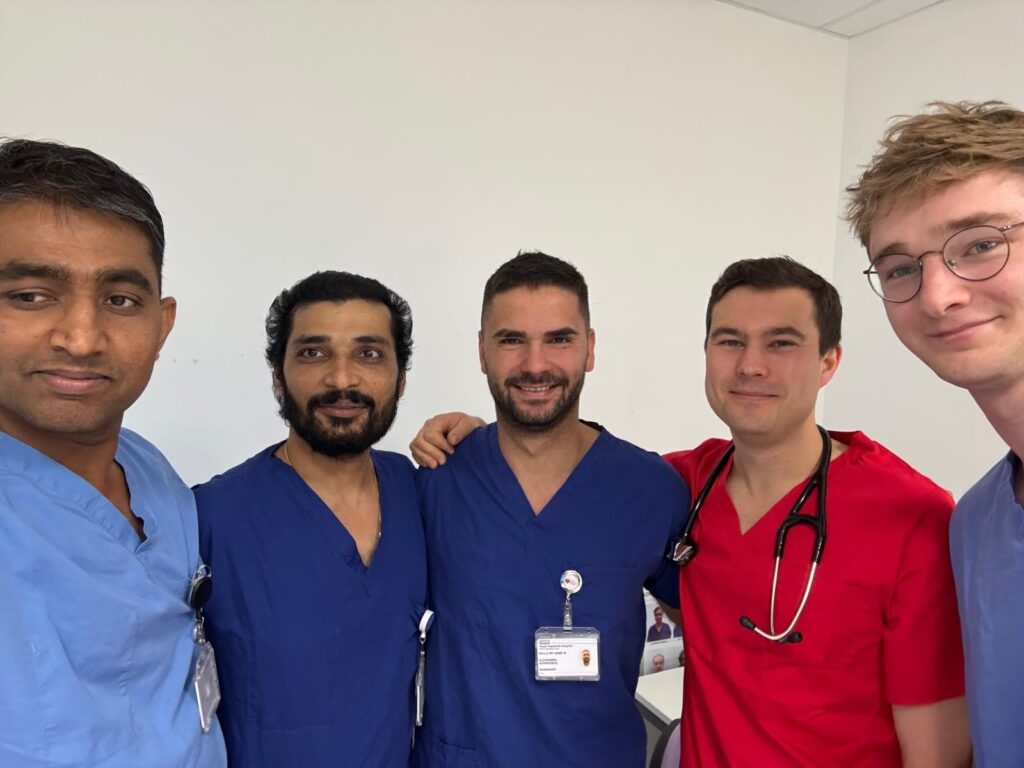
Once I completed my induction, I knew I had made the right choice. After being cleared by Occupational Health, I immersed myself in the daily activities of the Critical Care Department as an Honorary Senior Fellow. From the start, I was struck by the highly professional yet supportive environment—everyone was kind, approachable, and made me feel part of the team right away.
I discovered a system quite different from what I was used to: a multidisciplinary, patient-centred approach where hierarchy was minimal, and every team member was empowered to raise concerns. I was deeply impressed by the transparency and empathy shown towards patients and their families. Nurses, physiotherapists, speech and language therapists, nutritionists, pharmacists, ECMO specialists, and perfusionists all worked together seamlessly, like parts of a finely tuned mechanism, with the shared goal of achieving the best possible patient outcomes.

Daily ward rounds quickly became my favourite part of the day, offering insight into the team’s collective reasoning and care planning. I particularly enjoyed the noon multidisciplinary meetings with intensive care consultants, surgeons, cardiologists, radiologists, and microbiologists, where each patient’s progress was reviewed in depth.
My daily duties included caring for critically ill patients—many supported with complex extracorporeal mechanical devices—performing cardiac and lung ultrasound, bronchoscopies, inserting central and arterial lines, and accompanying patients to CT as the airway-trained doctor. One of the most fulfilling moments was taking patients to Papworth’s famous duck pond for “sunshine therapy,” allowing them to enjoy a change of scenery with their loved ones.
There were abundant educational opportunities for both junior and senior fellows, including weekly complex case reviews and monthly ECMO M&M meetings. I was also fortunate to attend a workshop on focused transoesophageal echocardiography, held in Cambridge during my stay. In addition, I became involved in clinical research, joining a remarkably active and motivated team that proudly maintained Papworth as one of the top recruiting sites in a national trial.

For several weeks, I also had the privilege of assisting in complex cardiac and thoracic surgery cases in the operating theatres, further broadening my experience in this demanding field.
To the entire team at Royal Papworth—please accept my deepest gratitude and respect. It was a true honour to work in one of the UK’s leading hospitals, an experience that challenged me, took me out of my comfort zone, and inspired me to keep learning and growing, both professionally and personally.
This fellowship has been invaluable. I return home inspired to build upon what I have learned and contribute to advancing ECMO care in Romania. As Sir Isaac Newton said:
“If I have seen further, it is by standing upon the shoulders of giants.”
Author
- Alexandru Novacescu, MD, PhD, E-AEC, Consultant in Anaesthesia and Intensive Care, Victor Babeș Hospital for Infectious Diseases and Pulmonology, Timișoara, Romania