






Newsletter
Comment on the first update of the ESAIC Venous Thromboembolism Guidelines
The ESAIC venous thromboembolism (VTE) guidelines provide a comprehensive and evidence-based framework for the prevention of VTE in clinical practice. These guidelines are pivotal for clinicians in improving patient outcomes by standardizing care protocols for VTE, which includes deep vein thrombosis (DVT) and pulmonary embolism (PE). They will be published as a whole in the August issue of the European Journal of Anaesthesiology (EJA). This very important issue will include an introduction chapter, an Executive Summary and twelve updated or new sections.
Strengths
- Evidence-Based Approach: The guidelines are grounded in the latest scientific evidence, ensuring that recommendations are based on the most recent and robust research. This helps in optimizing patient care and minimizing risks associated with outdated practices. The following ESAIC methodology was used with rigor:
- Selection of the topic by the Guidelines Committee
- Liaison with other European Specialist Societies which for some of them signed a « Memorandum of understanding » (ISTH, EAU, EURAPS, …)
- List of sections with the Chairs and the Writers proposed by ESAIC and each Specialist Society
- Design of the PICO questions (Patient, Intervention, Comparator, Outcome) and Key Words for each section (n=12).
- Literature search with a professional librarian (shared cost with the other partners). Screening of more than 16,000 articles.
- Production of listings.
- Selection of articles section by section using the Rayyan software with three rounds, focused first on the titles and then on the abstracts. Each selected article (final number above 400) was summarised using the Cochrane ROB spreadsheet (for randomised studies) and the SIGN spreadsheet for observational studies.
- Writing of the recommendations (6 to 8 per section) with a grading (GRADE method 1A to 2C) and a short rationale (800 to 1000 words).
- First round of Delphi vote (Online).
- Video conference with all the authors to ensure follow-up
- Second round of Delphi vote (Online)
- Final decision on grading after the second vote.
- Submission of the final text to the Guidelines Committee and the ESAIC Board of Directors for approval.
- Post for four weeks of the Guidelines on the ESAIC website for comments by the members
- Final publication in the European Journal of Anaesthesiology
- Total duration: three full years…
- Comprehensive Coverage: The guidelines cover a broad spectrum of scenarios, including perioperative care, critical care settings, and special populations such as pregnant women and cancer patients in thoracic surgery or urology. Plastic surgery is a new section, as are the non-ambulatory orthopaedic and trauma sections. The ambulatory-fast-track section, the cardiovascular section, and the neurosurgery section have also been updated. This extensive coverage ensures that the guidelines are applicable to a wide range of clinical settings.
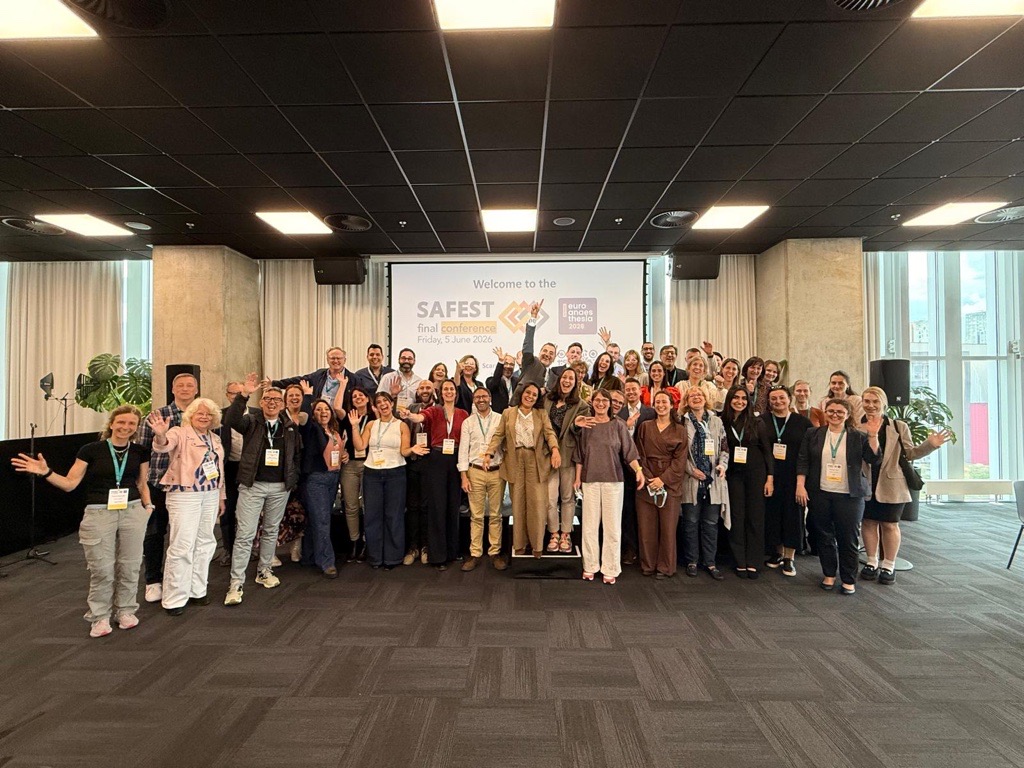
- Multidisciplinary Collaboration: The development of these guidelines involved a multidisciplinary team, including anaesthesiologists, intensivists, haematologists, and surgeons. This collaborative approach ensures that the guidelines are well-rounded and consider different perspectives and expertise. More than 12 international specialist societies have supported this and some of them have already endorsed these guidelines. Of note, the International Society on Thrombosis and Haemostasis (ISTH) has participated financially as other societies in the literature search, has sent several experts and has recently endorsed the text. This emphasises the high quality of these guidelines.
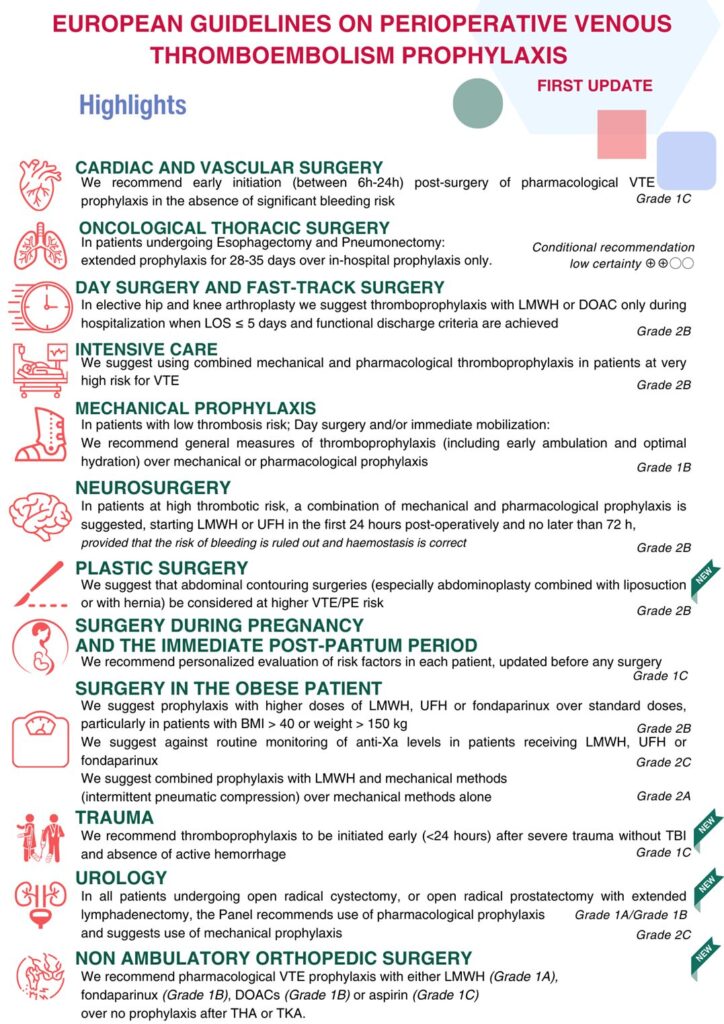
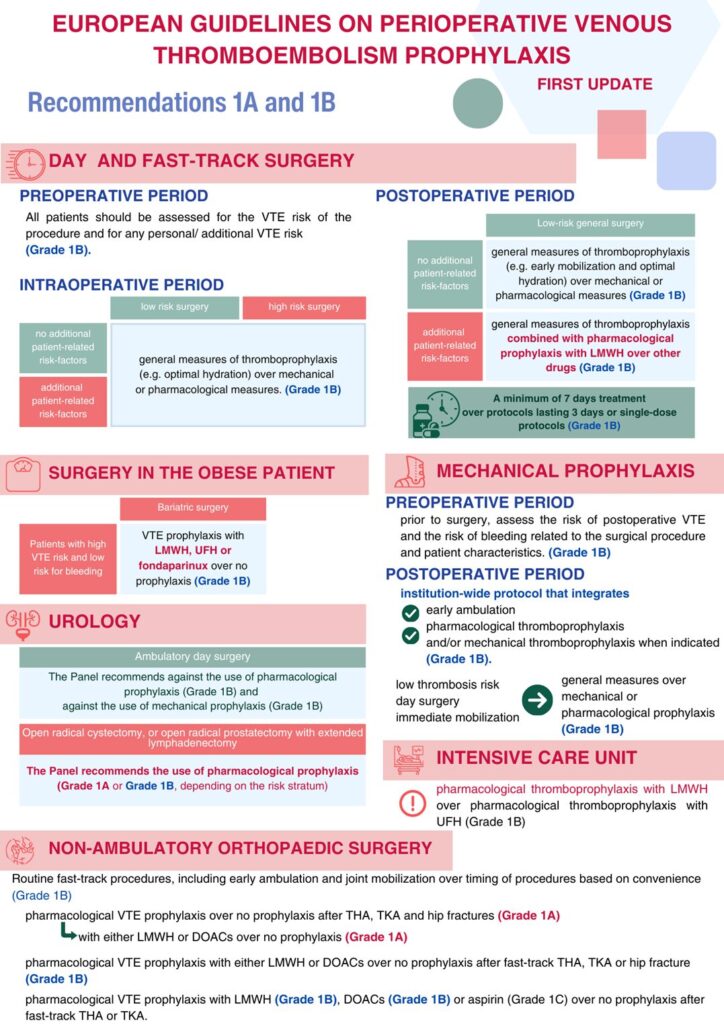
- Practical Recommendations: The guidelines provide clear and actionable recommendations, which are easy to implement in daily clinical practice. They include visual graphics that simplify decision-making processes for healthcare providers. Each section chair has also selected one recommendation out of his section (12 Highlights, figure 1) and the recommendations with a Grade 1A and 1B level have been gathered in a dedicated figure (figure 2).
- Risk Stratification: Emphasis on risk stratification allows for tailored prophylactic and therapeutic interventions. This personalised approach helps balance the benefits and risks of anticoagulation therapy, particularly in high-risk patients.
Areas for Improvement
- Implementation Challenges: While the guidelines are comprehensive, their implementation in resource-limited settings may pose challenges. Additional resources and training may be required to adapt these guidelines effectively in such environments. An App is foreseen, as for the first edition of these guidelines.
- Periodic Updates: The rapidly evolving nature of medical research necessitates frequent updates to clinical guidelines. Ensuring that the ESAIC guidelines are regularly reviewed and updated will be crucial to maintain their relevance and accuracy. The next update process should start no later than 2026.
- Patient Education: The guidelines could benefit from a stronger emphasis on patient education and engagement. Providing tools and resources to help patients understand their condition and the importance of adherence to prescribed therapies can enhance outcomes.
- Monitoring and Compliance: Recommendations on the monitoring of guideline adherence and compliance at institutional levels could be more detailed. Establishing metrics and feedback mechanisms would support continuous quality improvement.
Conclusion
The ESAIC venous thromboembolism guidelines are a valuable resource for clinicians, offering a thorough and practical framework for the management of VTE. While the guidelines are robust and evidence-based, addressing the challenges of implementation, ensuring regular updates, and enhancing patient education and technology integration will further strengthen their impact. Continuous efforts in these areas will help achieve better clinical outcomes and advance the standard of care for patients at risk of or suffering from VTE.
Note: This article has been written by us with the help of ChatGPT.
Authors
- Charles Marc Samama, Roberta Südy and Carolina Soledad Romero