





Newsletter
Join SUSTAIN-EUROPE: Mapping anaesthesia practice across Europe
Climate change poses an escalating threat to health worldwide.[1,2] Anaesthesiology societies have therefore called for action to reduce the environmental impact of clinical care.[3–6] Their recommendations include using regional anaesthesia and total intravenous anaesthesia where clinically appropriate and, when inhalational anaesthesia is required, favouring sevoflurane with minimal fresh gas flow.
However, the extent to which these approaches are used in everyday clinical care remains insufficiently documented. Europe-wide data on anaesthesia techniques, volatile anaesthetic use, fresh gas flow and ventilation practices are still limited.
Building a contemporary picture of anaesthesia practice
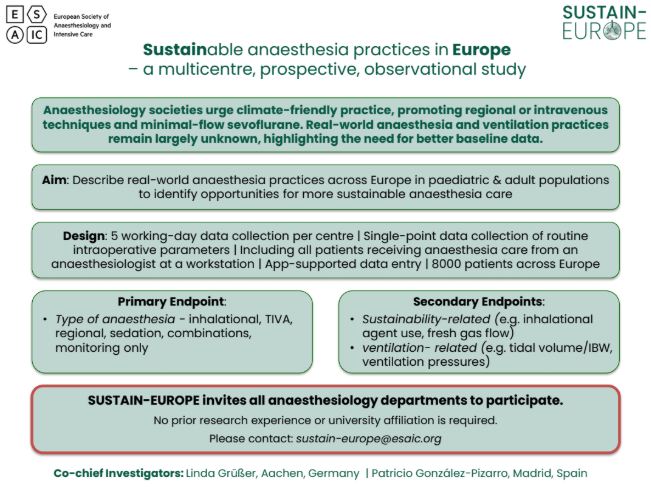
SUSTAIN-EUROPE will address this knowledge gap through a large, multicentre, prospective, observational study of routine anaesthesia practice in adult and paediatric populations. The study aims to enrol approximately 8,000 patients across Europe. Participating centres will collect routine intraoperative data over five working days using a dedicated data-entry app. The primary endpoint is the type of anaesthesia provided, including inhalational general anaesthesia, total intravenous anaesthesia, regional anaesthesia, sedation, combinations of techniques and monitoring only.
Secondary endpoints include sustainability-related parameters, such as the inhalational agent used and fresh gas flow, as well as ventilation-related variables, including tidal volume relative to ideal body weight and ventilation pressures.
By documenting how anaesthesia is delivered across different hospitals and healthcare settings, SUSTAIN-EUROPE will provide a contemporary snapshot of practice across Europe. The findings will help identify variations in care and potential opportunities for future research and more environmentally sustainable anaesthesia practice.
Designed for straightforward participation
Participation has been designed to minimise the workload for local teams. Each centre will collect data for only five working days using a short case report form and, for the first time within the ESAIC Clinical Trial Network, a dedicated app supporting efficient data entry.
Anaesthesiology departments of all sizes are encouraged to participate. No previous research experience or university affiliation is required.
SUSTAIN-EUROPE is supported by the European Society of Anaesthesiology and Intensive Care Clinical Trial Network following its selection for an ESAIC CTN Grant. The study is registered on ClinicalTrials.gov under NCT07252973.
Register your centre
The call for centres is now open.
Join anaesthesiology departments across Europe in this collaborative study and help generate the evidence needed to guide more sustainable clinical practice.
Questions may be sent to sustain-europe@esaic.org.
Authors: Linda Grüßer, MD, MPH
University Hospital RWTH Aachen, Aachen, Germany
Patricio González-Pizarro, MD, PhD
La Paz Children’s Hospital, Madrid, Spain
On behalf of the SUSTAIN-EUROPE Steering Committee: Karin Becke-Jakob, Universitäts-Kinderspital beider Basel (UKBB), Switzerland; Anna Camporesi, “V. Buzzi” Children’s Hospital, Milan, Italy; Mark Coburn, University Hospital Bonn, Bonn, Germany; Nicola Disma, IRCCS Istituto Giannina Gaslini, Genoa, Italy; Alexander Fuchs, Inselspital, University Hospital Bern, Bern, Switzerland; Sabrine N T Hemmes, The Netherlands Cancer Institute – Antoni van Leeuwenhoek Hospital, Amsterdam, the Netherlands; András Keszei, Medical Faculty, RWTH Aachen University, Aachen, Germany; Ana Kowark, University Hospital Bonn, Bonn, Germany; Jan Larmann, University Hospital RWTH Aachen, Aachen, Germany; David van Meenen, Amsterdam UMC, Amsterdam, the Netherlands; and Nicolaas H Sperna Weiland, Amsterdam UMC, Amsterdam, the Netherlands.
References
- Romanello M, Walawender M, Hsu S-C, et al. The 2024 report of the Lancet Countdown on health and climate change: facing record-breaking threats from delayed action. Lancet. 2024;404(10465):1847–1896. https://doi.org/10.1016/S0140-6736(24)01822-1.
- World Health Organization. A global health strategy for 2025–2028: advancing equity and resilience in a turbulent world. Fourteenth General Programme of Work. Geneva: World Health Organization; 2025. Licence: CC BY-NC-SA 3.0 IGO.
- Gonzalez-Pizarro P, Brazzi L, Koch S, et al. European Society of Anaesthesiology and Intensive Care consensus document on sustainability: 4 scopes to achieve a more sustainable practice. Eur J Anaesthesiol. 2024;41(4):260–277. https://doi.org/10.1097/EJA.0000000000001942.
- Schuster M, Richter H, Pecher S, et al. Positionspapier mit konkreten Handlungsempfehlungen der DGAI und des BDA: Ökologische Nachhaltigkeit in der Anästhesiologie und Intensivmedizin – Aktualisierung 2024. Anästh Intensivmed. 2024;65:541–557. https://doi.org/10.19224/ai2024.541.
- White SM, Shelton CL, Gelb AW, et al. Principles of environmentally sustainable anaesthesia: a global consensus statement from the World Federation of Societies of Anaesthesiologists. Anaesthesia. 2022;77(2):201–212. https://doi.org/10.1111/anae.15598.
- Australian and New Zealand College of Anaesthetists and Faculty of Pain Medicine. PS64(G) Position statement on environmental sustainability in anaesthesia and pain medicine practice. 2019.