






Newsletter
Seeing the Patient, Not Just the Numbers
Situation awareness, patient safety and the next visual layer in patient monitoring
The question behind the technology
At Euroanaesthesia, the most interesting ideas are not always the ones that sound most futuristic on stage. They are the ones that follow us back into the operating room on Monday morning.
One such idea is deceptively simple: How can a team see the patient clearly enough to act together?
Modern perioperative patient monitoring has been one of the great safety achievements of anaesthesia. Numbers, waveforms and alarms are precise, familiar and indispensable. They guide titration, rhythm interpretation, ventilation, haemodynamics, temperature management and documentation. None of this should be romanticised away.
Yet every anaesthesiologist knows the other side of the story. Monitoring is rarely read under perfect conditions. It is read while inducing anaesthesia, answering a question, adjusting a ventilator, preparing a handover, reacting to an alarm or looking after more than one patient. We do not calmly study the monitor. More often, we glance, integrate and decide.
That is where the human-factors problem begins. It is not enough that information is present. The team must be able to build the right clinical picture quickly. When that picture is unnecessarily hard to build, this is no longer a matter of elegance or screen design. It becomes dangerous: relevant changes may be recognised later, interpreted differently by different team members, or fail to become a shared call to action.
Figure 1 shows the idea in practice: not less monitoring, but a different first glance.
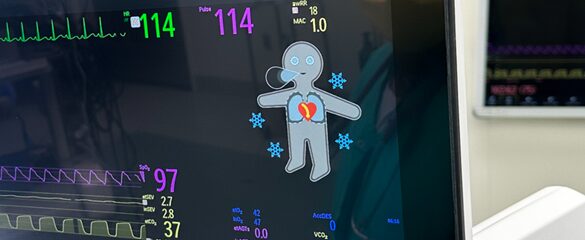
Figure 1. Split-screen patient monitoring in the operating room: conventional waveforms and numerical values remain available for detailed interpretation, while a patient-shaped visual layer supports rapid orientation and shared situation awareness. Photo provided by the author.
Situation awareness is a safety layer
Situation awareness is usually described as three steps: perceiving what is happening, understanding what it means and anticipating what may happen next.1 In anaesthesia and intensive care, this is not an abstract cognitive theory. It is the basis for prioritising, communicating and acting.
When situation awareness fails, it is rarely because clinicians do not care. It is often because the clinical environment asks humans to do something humans are not naturally good at: read many small, changing numbers in sequence, mentally combine them into a patient state and do so while the room keeps moving. In one analysis of 200 critical incidents in anaesthesia and critical care, situation-awareness errors were identified in 81.5% of cases, mostly at the levels of perception and comprehension.2
That should make us humble. It also gives us a direction.
Another layer in the Swiss cheese
James Reason’s Swiss Cheese Model remains useful because it refuses the fantasy of a single perfect safety solution. Patient safety comes from layers: training, standards, checklists, alarms, teamwork, culture, technology and clinical judgement. Every layer has holes. Safety improves when the holes are less likely to align.3
Monitor design is one of those layers. It will not prevent all errors. It should never be sold as doing so. But it can make one hole smaller: the moment when information is technically available but not seen, not understood or not shared quickly enough.
This is how I think about the Visual Patient Avatar: not as a replacement for clinical thinking, and certainly not as a replacement for numbers, but as an additional protective layer for clinical thinking.
A patient-shaped overview beside the numbers
The Visual Patient Avatar translates vital-sign information into an animated, patient-shaped image. Oxygenation, ventilation, circulation, temperature, neuromuscular relaxation and other physiological domains are represented through colour, motion, shape and anatomical location.
The important word is beside. The clinically useful configuration is split-screen monitoring: the avatar gives the rapid overview; the established monitor provides exact values, waveforms, trends, alarm settings and details for treatment decisions. Numbers remain strong where precision is needed. A picture is strong where orientation is needed. Good monitoring should not force us to choose between the two.
There may be no more natural way to depict the state of a patient than through a model of a patient. That sounds almost too obvious. But perhaps obvious is exactly what good interface design should feel like after enough work has gone into it.
Why the idea resonates
Current implementation data shared with me indicate that the technology is now present in more than 140 hospitals in 45 countries, across operating rooms, ICUs and emergency departments. The number itself is not the message. The interesting part is that the idea resonates across very different clinical cultures.
Why? I suspect because the underlying human problem is universal. We work in different languages, systems and hierarchies, but when it comes to perception, we are all human. We see patterns, colours, motion and body forms faster than we read rows of numbers. We recognise a visual whole before we consciously assemble its parts.
The avatar also does something subtle. It reminds us that the data belong to a patient. This matters in interprofessional care. A shared visual object can help nurses, anaesthesiologists, surgeons, intensivists, trainees and emergency teams speak from the same starting point. That is not only convenience. It is a form of care equality: broader access to the same clinical picture.
And yes, the interface is friendly. In paediatric settings this becomes particularly visible. What some may call cute can be a strength when it makes a clinical situation more approachable, explainable and shareable. Serious design does not have to look severe.
What the evidence already tells us
The strongest evidence so far concerns the first two levels of situation awareness: perception and comprehension. In the original comparative study, anaesthesia professionals recalled nearly twice as many vital signs with the avatar as with conventional monitoring, with higher confidence and lower perceived workload.4
Peripheral-vision research then asked a very practical question: what happens when clinicians are not looking directly at the monitor? In a multicentre eye-tracking study, avatar-based monitoring allowed substantially more vital-sign changes to be detected outside the foveal centre of vision than conventional monitoring.5 This matters because in real clinical work our sharpest attention is often on the patient, the airway, the procedure or the team member speaking to us.
Multiple-patient monitoring is another everyday challenge. In a central-monitor study, anaesthesia professionals monitoring several patients simultaneously remembered more vital signs in short scenarios with the avatar than with conventional display, with lower workload.6 The point is not that an avatar replaces deliberate review. It helps in the screening phase: deciding where closer attention should go.
High-fidelity simulation adds clinical realism. In simulated critical anaesthesia events, split-screen monitoring with avatar and conventional display was not inferior for critical tasks, and avatar use improved verbalisation of the emergency cause in some analyses.7 That is precisely the kind of shared understanding teams need in crisis: not only seeing that something is wrong, but naming what is wrong.
Distant-viewing work showed that avatar-based monitoring improved remote vital-sign recognition at 8 and 16 metres compared with conventional monitoring.8 Real-world implementation studies in operating rooms, post-anaesthesia care and intensive care have described useful situations around rapid overview, temperature, oxygen saturation, high workload, handovers and daily routines.9 In paediatric anaesthesia, clinicians reported that children often reacted positively and with interest to the avatar, while also pointing to important improvement needs, including age-adapted thresholds and continued access to quantitative information.10
These results do not prove that an avatar improves hard patient outcomes. That would be too much claimed. They show something preceding outcomes and nevertheless important: information can be designed so that it is perceived faster, understood with less mental strain and shared more easily.
The work ahead
The beginning has been made. Now it has to continue.
The next phase is not to declare victory, but to ask harder clinical questions: Can situation-awareness-oriented monitoring reduce alarm burden? Can it shorten time outside target ranges? Can it reduce delayed recognition? Can it improve handovers, team communication and interprofessional shared mental models? Can patient-specific thresholds become more intelligent, more flexible and easier to use? Can visual and auditory cues be integrated so that monitors support attention rather than compete for it?
These are not distant questions for us. They are the studies we are working toward.
The larger vision is not a prettier monitor. It is a better situation-awareness system for our specialty: integrated data, meaningful alarms, patient-specific limits, visual explanations and interfaces that help teams see the clinical picture before they have to act. If our goal is to represent the patient, then a patient-shaped model is not a gimmick. It may be the most logical place to start.
For me, this is the real promise. Not technology instead of people. Not pictures instead of numbers. But monitoring that makes people better at what only people can do: recognise meaning, set priorities, take responsibility, protect patients and act as a team.
Behind every monitor, every number and every alarm is a patient we are trying to protect. The future of anaesthesiology and intensive care will be better when our screens help us see that patient sooner, share the situation faster and find the next safe action together.
David W. Tscholl, MD
Institute of Anaesthesiology and Perioperative Medicine, University Hospital Zurich; University of Zurich
References
1. Endsley, M. R. (1995). Toward a theory of situation awareness in dynamic systems. Human Factors, 37(1), 32-64.
2. Schulz, C. M., Krautheim, V., Hackemann, A., Kreuzer, M., Kochs, E. F., & Wagner, K. J. (2016). Situation awareness errors in anesthesia and critical care in 200 cases of a critical incident reporting system. BMC Anesthesiology, 16, 4.
3. Reason, J. (2000). Human error: Models and management. BMJ, 320(7237), 768-770.
4. Tscholl, D. W., Handschin, L., Neubauer, P., Weiss, M., Seifert, B., Spahn, D. R., et al. (2018). Using an animated patient avatar to improve perception of vital sign information by anaesthesia professionals. British Journal of Anaesthesia, 121(3), 662-671.
5. Pfarr, J., Ganter, M. T., Spahn, D. R., Noethiger, C. B., & Tscholl, D. W. (2019). Avatar-based patient monitoring with peripheral vision: A multicenter comparative eye-tracking study. Journal of Medical Internet Research, 21(7), e13041.
6. Garot, O., Rossler, J., Pfarr, J., Ganter, M. T., Spahn, D. R., Noethiger, C. B., et al. (2020). Avatar-based versus conventional vital sign display in a central monitor for monitoring multiple patients: A multicenter computer-based laboratory study. BMC Medical Informatics and Decision Making, 20, 26.
7. Roche, T. R., Said, S., Braun, J., Maas, E. J. C., Machado, C., Grande, B., et al. (2021). Avatar-based patient monitoring in critical anaesthesia events: A randomised high-fidelity simulation study. British Journal of Anaesthesia, 126(5), 1046-1054.
8. Milovanovic, P., Braun, J., Hunn, C. A., Lunkiewicz, J., Tscholl, D. W., & Gasciauskaite, G. (2025). Avatar-based versus conventional patient monitoring with distant vision: A computer-based simulation study. Journal of Clinical Monitoring and Computing, 39(5), 1065-1075.
9. Radaviciute, I., Hunn, C. A., Lunkiewicz, J., Milovanovic, P., Willms, J. F., Noethiger, C. B., et al. (2024). Survey-based qualitative exploration of user perspectives on the Philips Visual Patient Avatar in clinical situation management. Scientific Reports, 14, 22176.
10. Lunkiewicz, J., Fries, D., Milovanovic, P., Noethiger, C. B., Tscholl, D. W., & Gasciauskaite, G. (2023). Pediatric anesthesia providers’ perspective on the real-life implementation of the Philips Visual Patient Avatar: A qualitative study. Children, 10(12), 1841.
Disclosure
The author is a co-inventor of Visual Patient technologies. The University of Zurich and Philips hold related intellectual property. The author may receive royalties and has received research funding, travel support and/or honoraria related to these technologies. The views expressed are the author’s own. ChatGPT was used to support language editing, structure, and stylistic refinement; all content, references, interpretations, and conclusions were critically reviewed, fact-checked, and approved by the author, who takes full responsibility for the manuscript.