




ESAIC News
New ESAIC consensus document supports more sustainable Intensive Care Medicine
ESAIC has published a new consensus document on mitigation strategies in Intensive Care Medicine, offering practical recommendations to help reduce the environmental footprint of intensive care while keeping patient safety and quality of care at the centre.
The publication marks another important step in ESAIC’s ongoing sustainability work. It builds on the ESAIC Glasgow Declaration on Sustainability in Anaesthesiology and Intensive Care, launched in 2023, which called on healthcare professionals, policymakers, professional societies, patients and other stakeholders to become ambassadors for environmental sustainability in healthcare.
Since then, ESAIC has continued to develop resources, guidance and initiatives to help translate this commitment into clinical practice. This new document brings that work into a focused Intensive Care Medicine context, supporting teams in identifying where environmental improvements can be made safely, responsibly and practically.
Intensive care medicine is one of the most resource-intensive areas of the hospital. Intensive care units require high energy use, specialised equipment, continuous monitoring, large volumes of single-use materials and complex medication pathways. As a result, they represent an important area for action when addressing the environmental impact of healthcare.
“Intensive care medicine is both a contributor to and a victim of environmental degradation,” explained Assoc. Prof. Dr Susanne Koch, member of the ESAIC Sustainability Committee. “As climate change increasingly affects health and healthcare systems, ICUs are a particularly important place to drive meaningful change.”
The new ESAIC consensus document focuses on practical mitigation strategies for Intensive Care Medicine. Its recommendations cover four key areas: energy use, waste management, medication use, and environmental ethics. Together, these areas reflect the need for a broad approach, combining clinical decision-making with hospital leadership, procurement, infrastructure, education and quality improvement.
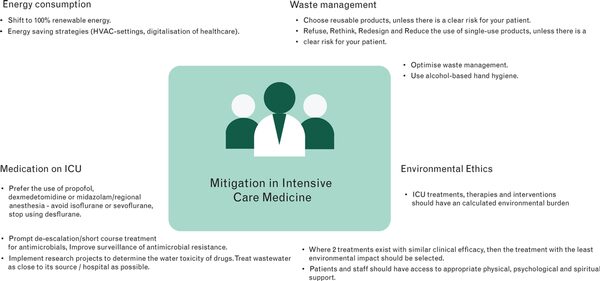
Figure 1: Conceptual framework of mitigation strategies in intensive care medicine: Organised across four domains: energy consumption, waste management, ICU medication use, and environmental ethics.
The document also reinforces a key principle of ESAIC’s sustainability work: environmental action must go hand in hand with patient safety. Sustainability in intensive care is not about reducing standards of care, but about identifying where unnecessary resource use, waste or environmental harm can be reduced safely and responsibly.
“Sustainability is no longer an optional extra in intensive care medicine. It should become part of routine quality improvement and clinical decision-making,” said Susanne Koch. “Our goal is to help ICUs reduce their environmental footprint while maintaining the highest standards of patient care.”
For intensive care teams, the document provides a framework that can be adapted to different local circumstances. Some measures require hospital-wide decisions, including the transition towards fossil-free energy, energy procurement, infrastructure planning and the management of heating, ventilation and air-conditioning systems. Others can begin at department level, such as reviewing waste streams, improving stock management, avoiding the unnecessary opening of equipment, reducing medication waste and involving multidisciplinary teams in sustainability initiatives.
Energy use is particularly important. According to the consensus document, energy consumption can account for most of an ICU patient’s carbon footprint, with heating, ventilation and air-conditioning systems often using more energy than medical equipment.
“A practical first step is to work closely with facilities and engineering teams to review heating, ventilation and air-conditioning settings,” Susanne Koch explained. “Optimising temperature, ventilation and airflow according to actual clinical needs can reduce energy use without compromising patient care. It can also deliver measurable environmental benefits at relatively low cost and may generate financial savings over time.”
The document also recommends establishing multidisciplinary Green Teams that bring together intensivists, nurses, pharmacists, engineers, procurement specialists and hospital leadership. These teams can coordinate action, share good practices and help integrate sustainability into existing quality and patient-safety structures.
Waste management is another central theme. While recycling remains important, the consensus document encourages teams to intervene earlier in the waste pathway by considering whether materials are needed in the first place, whether reusable alternatives can be introduced safely and whether equipment can be repaired rather than replaced.
This reflects a wider shift from managing waste after it has been produced to preventing avoidable waste. Better procurement decisions, improved stock control and reducing unnecessary reliance on single-use products can all contribute to more sustainable intensive care.
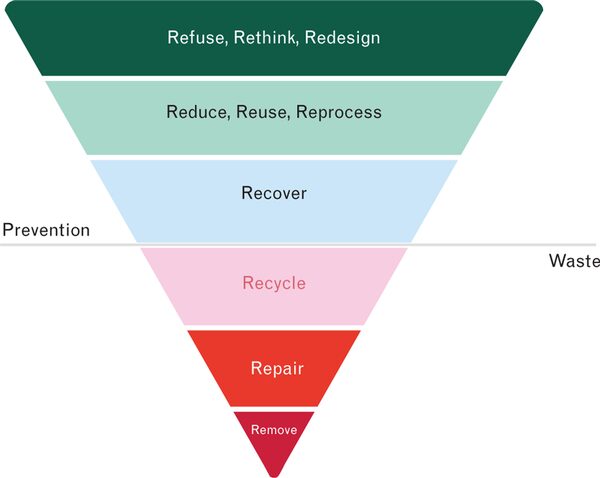
Figure 2: The 10 Rs waste hierarchy
Medication use is also addressed in detail. The recommendations encourage clinicians and departments to consider environmental impacts when clinically equivalent options are available, while always prioritising patient safety and appropriate care.
The document highlights the need to reduce avoidable medication waste, limit environmental contamination and support responsible antimicrobial use. It also draws attention to the environmental impact of volatile anaesthetics used for ICU sedation.
“One of the most effective actions an ICU can take is to stop using desflurane and minimise the use of sevoflurane and isoflurane whenever clinically feasible,” said Susanne Koch. “Teams should also reduce unnecessary medication waste and consider environmental impact when different treatments provide comparable clinical outcomes.”
The ethical dimension is equally important. The document proposes that when two clinical options offer similar levels of safety and effectiveness, clinicians should consider selecting the option with the lower environmental impact.
It also calls for environmental-impact data to become more widely available for ICU treatments, therapies and interventions. Better information would allow healthcare professionals to make evidence-based choices that take account of both clinical outcomes and environmental consequences.
The publication forms part of ESAIC’s broader sustainability framework, which includes the Glasgow Declaration, the 2024 ESAIC consensus document on sustainability, the ESAIC Sustainability Toolkit and ongoing work by the Sustainability Committee and National Society representatives.
Together, these initiatives aim to move the specialty from awareness to implementation, making sustainable practice a routine part of anaesthesiology and intensive care.
The next step is local action. ESAIC encourages members to read the consensus document, share it with colleagues in intensive care, anaesthesiology, pharmacy, procurement, hospital management, engineering and sustainability teams, and consider how its recommendations can be applied within their institutions.
By connecting scientific consensus with practical action, ESAIC continues to support a more sustainable future for anaesthesiology and intensive care—one that protects patients today while recognising healthcare’s responsibility towards future generations.