





Newsletter
Simulation Working Group: Driving Innovation in Anaesthesiology Education Across Europe
Introduction
Simulation-based learning (SBL) has become an essential pillar of modern anaesthesiology and intensive care education. It offers a safe, structured environment for clinicians to acquire technical skills, refine decision-making, and develop non-technical competencies such as communication and teamwork—without risk to patients. Recognising its transformative potential, the Simulation Working Group within the NASC representatives was established at the Euroanaesthesia congress in Lisbon in 2025 to advance simulation practices across Europe, foster collaboration, and facilitate the integration of simulation training into specialist training for anaesthesiologists and intensivists, and into lifelong learning.
Our Aims and Planned Projects
The mission of the Simulation Working Group is clear: to promote best practices in simulation-based education and training (SBET), support faculty development, and explore innovative technologies that enhance learning outcomes. Our objectives for 2026 include:
- Mapping Current Practices: Through surveys and collaborative research, we aim to understand how SBET is currently implemented across European training programs and the diversity across countries.
- Dissemination of information: The ESAIC is strongly committed to sharing highquality educational content with its members and the wider anaesthesiology community. Through the online elearning platform myESAIC, regular webinars, and structured Masterclasses, the ESAIC provides accessible, uptodate training opportunities across a wide range of clinical and educational topics. Educational materials produced by the ESAIC committees—including guidelines, recommendations, and expert interviews—are disseminated through newsletters, social media, and the ESAIC website. The goal is also to spread information about EDAIC exams and other ESAIC products, such as CEEA courses, and the availability of ATAIC (Accreditation of Teaching Activities) for academic anaesthesia departments meeting European Training Requirements.
- Exploring Emerging Technologies: Artificial Intelligence, Virtual Reality (VR), Augmented Reality (AR), and Extended Reality offer exciting opportunities for immersive learning. The Simulation Working Group is committed to evaluating these tools and supporting their safe and effective implementation in SBET. This will provide insights into current adoption, barriers, and success stories in VR for simulation-based education. Emerging tools such as VR and AR promise to make simulation even more accessible and engaging. These technologies can replicate complex scenarios, provide real-time feedback, and support remote learning—opening new possibilities for education in low-resource regions with no available simulation centre.
- Faculty Development: High-quality simulation depends on skilled facilitators and structured debriefing. We plan to support the expansion of faculty training programs to strengthen these critical elements.
- Simulation Ambassadors: A common achievement of the Simulation Committee and the Simulation Working Group has been establishing Simulation Ambassadors in most ESAIC member countries. These ambassadors serve as local champions, bridging the gap between national societies and the ESAIC. Their role, in addition to their connection within the ESAIC, is to promote simulation initiatives at national and regional levels, exchange best practices, and support countries at different stages of implementation.
One of our flagship initiatives for 2026 is a survey on simulation-based training in the residency curriculum. The survey was sent out at the beginning of 2026 to all NASC representatives and the ESAIC Simulation Ambassadors and explores how simulation is used across our European countries, how frequently, and in what formats. It also focuses on whether or not VR is being implemented in simulation-based learning.
By fostering collaboration and sharing resources, we aim to accelerate the integration of simulation into training programs across Europe.
Collaboration within the ESAIC:
- Educational Committee (Simulation Committee, Train The Trainer Committee)
- Sustainability Committee
Example of good practice: The Czech Society of Anaesthesiology and Intensive Care (ČSARIM)
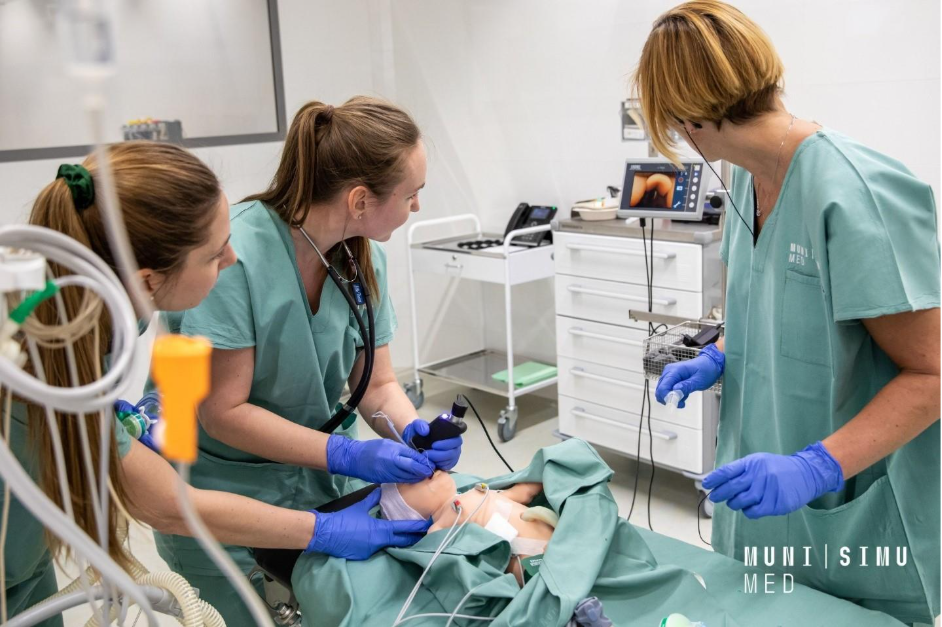
The Czech Society of Anaesthesiology and Intensive Care is one of the national societies that implemented the SBET as an obligatory part of training. Since 2021, there has been a 2-day course on Managing critical events in Anaesthesia and Critical Care, which is a mandatory part of specialist training. The course focuses on high-fidelity simulation of life-threatening scenarios in the operating theatre and intensive care. Besides the crisis, resource management is also focused on technical skills training. 34 courses at 4 different simulation centres (from 8 accredited simulation centres at medical faculties) have already been held since the course’s accreditation, with over 400 participants. The course has the same structure across all centres: 1st day: crisis management in adult anaesthesia; 2nd day: crisis management in intensive care and paediatric anaesthesia. However, the number of simulation scenarios varies between 10 and 17 in total, and the number of skill stations varies from 0 to 2.
Innovation in Intensive Care Training: In 2023, the first accredited course on crisis management in intensive care medicine was introduced as mandatory in the Intensive Care subspecialty. A fullday simulation-based training in this course guides participants through managing critical scenarios such as STEMI, tachyarrhythmias, CICO, septic shock, trauma, COPD exacerbation, hypoxemia, and patient transport. It combines scenario-based simulations with focused workshops, including airway management, ventilation training, and POCUS ultrasound skills. 5 courses over the last three years were organised at a single simulation centre accredited for this course, with 67 participants.
Facultative courses are also offered, focusing on subspecialities such as paediatric anaesthesia, paediatric emergencies, critical care, adult anaesthesia, and ultrasound, which are not connected to speciality training.
The Czech experience demonstrates how national societies can successfully implement structured simulation programs, even in resource-constrained environments. Collaboration with the ESAIC and SESAM has further strengthened these efforts, ensuring alignment with European standards and facilitating knowledge exchange.
Tips and tricks for SBET implementation from ČSARIM:
Organisational:
- Advanced planning (yearly, monthly)
- Timer – time management application – all stakeholders are synchronised in seconds throughout the course schedule.
- Involvement of real anaesthetic/ICU nurses in High-fidelity simulations
- Simulation technician and audiovisual technician available
- Catering on site for both participants and teachers
Educational:
- Safe learning environment
- Enrolment of basic situations (not the rare complications)
- Active involvement of all participants as many times as possible in different roles
- Focus on a structured approach and CRM principles
- 4-step (3-step) approach for skills training
- Trained faculty from clinical praxis (two per group of a maximum of 10 participants)
- Scrubs and equipment to increase realism
Feedback:
- Mandatory direct feedback at the end of the course from participants
- Feedback from the faculty and technicians
- Regular feedback evaluation and subsequent course adjustment if needed
Call to Action
We invite all the ESAIC members to join us in shaping the future of simulation-based education:
- Engage with your Simulation Ambassador to share experiences and best practices.
- Attend the ESAIC workshops and webinars to stay informed about the latest developments.
Together, we can ensure that simulation becomes an integral part of anaesthesiology and intensive care training—enhancing patient safety, improving clinical outcomes, and preparing clinicians for the challenges of tomorrow.

Author: Martina Kosinova, Petr Stourac